Have a child, plant a tree, write a book
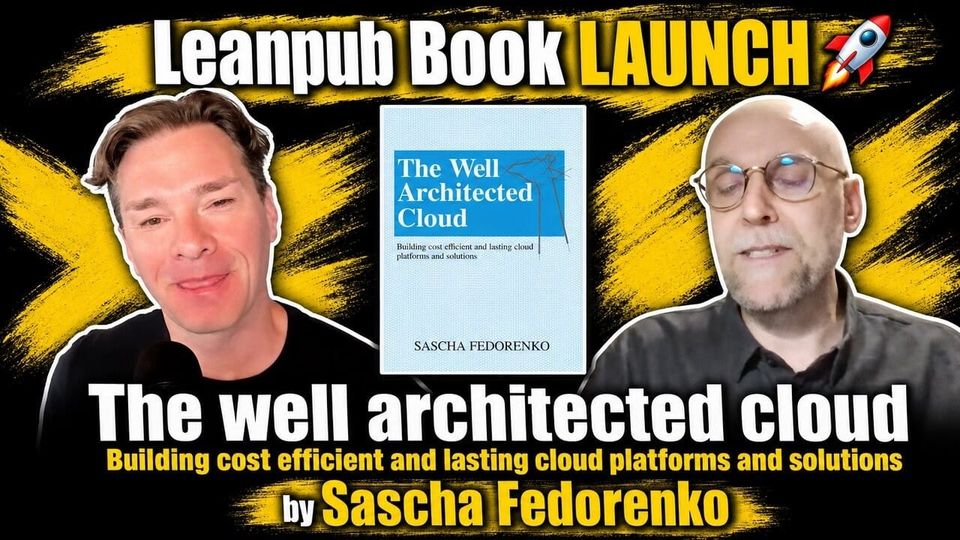
Today’s Best Band Ever™ is not happening - one video per post is enough.
Instead, today it's yours truly. I published a book.
The world and the tech
I left Ukraine more than twenty years ago, but I still have family there. So when there is news about Ukraine finally hitting pootin's symbolic and illegal bridge, it gives me hope. Especially when Ukrainians had to come up with an alternative to Starlink after US partners did all they could to "help".
In other news, I've just returned from the Gartner IO conference in London, and it's been ... interesting. While AI was in the title of virtually every talk, the focus was on security, cost, etc. In other words, business as usual. The main difference is that when Gartner used to make five- and ten-year projections, now they mostly talk about the next year.
Sovereignty
One of the main topics (apart from AI, of course) was digital sovereignty. Today Gartner defines digital sovereignty as covering three categories:
- Data
- Operations
- Technology
Data sovereignty
This covers where one's data is stored and who has access to it. The most prominent example is the CLOUD Act that allows the US government to request access to data held by any US company, independently of where the data is located. Famously, Microsoft confirmed that they will not be able to guarantee that French citizens' data would never reach US authorities. Keep in mind, international law already enabled this scenario when, for example, the French government asked the Swiss government for assistance. The difference between this case and the CLOUD Act is that the "traditional" way requires both governments to cooperate and agree that a crime took place, while the CLOUD Act just allows the US government to talk directly to the company in question.
Operational sovereignty
This one covers who operates one's infrastructure and has the power to turn it off or even delete it. An example of the data and operational sovereignty concerns is Basel-Stadt deciding to outsource VPN management to a US company. In my opinion, for governments data and operational sovereignty are not optional - citizens' data and services should not be under the control of a foreign actor.
Technological sovereignty
This concern is about who controls the software one is using. It is largely covered by open source vs. proprietary and technical debt. Both share the same question: "how difficult is it to switch to an alternative solution?" Remember the Outlook outage? That was a perfect trifecta of a US company holding your data, operating your software and being the only vendor of Microsoft Outlook (lock-in). They say you can have a crippled limited version of it as part of their "M365 local" offering, but if you want to be free of their technology, doing so requires a serious (but potentially profitable) migration.
Technical debt and lock-in are the root causes of technological sovereignty concerns. In general, they are nothing but decisions that had to be made in the past, and, as they age, carry a risk of snowballing costs if left to their own devices.
Cybersecurity
It's not exactly news, but before the AI, in 2018, a security exploit would enjoy an average of 63 days before being used in the wild. It went down to 5 days in 2023. The scanning related to Php2Shell was reported 5 hours after the CVE was disclosed.
Cybersecurity has a mantra: "assume the breach". Today there's no more excuse to treat that as a hypothetical - one has to work from the assumption that at any given moment they have multiple concurrent successful breaches. This means that mostly-preventive measures are largely inadequate - one has to architect their systems (solutions, networks) so that they
- Prevent or at least limit the propagation via good architecture
- Detect the breach
- Remediate or quarantine
Thus, least privilege, zero trust, micro-segmentation, explicit service mesh (where two systems are only connected if explicitly requested) and only then detection and remediation.
Prevention and hygiene are still relevant, but they're just not enough (and frankly never were).
Cloud
The AI hype seems to be settling down and while AI is here to stay, many are discovering that AI, like everything else, still runs in the cloud. With many AI practitioners "discovering" or reinventing FinOps and cost efficiency (which is largely supported by the "cloud-nativeness" of the architecture).
For example, MCP initially used two SSE connections, which implied a persistent connection - breaking the "only when needed" principle. Now, with MCP switching to Streamable HTTP, things have improved. And this is likely the reason why AWS added Web Application mode to Lambda.
Another popular approach with GenAI is to place a central AI gateway for authentication and routing. While not a bad idea per se, some companies are discovering that a centralized (for the sake of control - tokenomics!) approach makes cost attribution difficult (making cost control harder). But things get messy when Claude Code is used, for example, with Microsoft Foundry in a shared subscription - it becomes hard to attribute individual API calls to the right payers.
Traditional centralization is an antipattern in cloud. For example, the separation into accounts in AWS and subscriptions in Azure was not only a method for blast-radius reduction, but a very effective way of cost attribution.
Commonly, Enterprise Architecture strives to have one system for each capability. For example, using Postgres as a standard database (good idea!). This doesn't mean, though, that an organization should create one single Postgres DB and make everyone use it. The same template with multiple instances is the proper cloud way.
The book
With all the attention on AI, cloud has become a secondary concern - after all, AI is magic that will solve everything (spoiler: for the most part it's not, it's a multiplier, not a solution by itself). The good news is that Gartner expects cloud to recover its relevance in about two years. This means my book is either two years too early or two years too late.
Yes, it's official. After almost two years of writing and giving up, I've released the first complete version of my book "The Well Architected Cloud." (It's complete as in covering all the bases, but the subject is still developing, so I could never call it finished.)
In case you're wondering, yes, cybersecurity and digital sovereignty (among other things) are covered in my book.
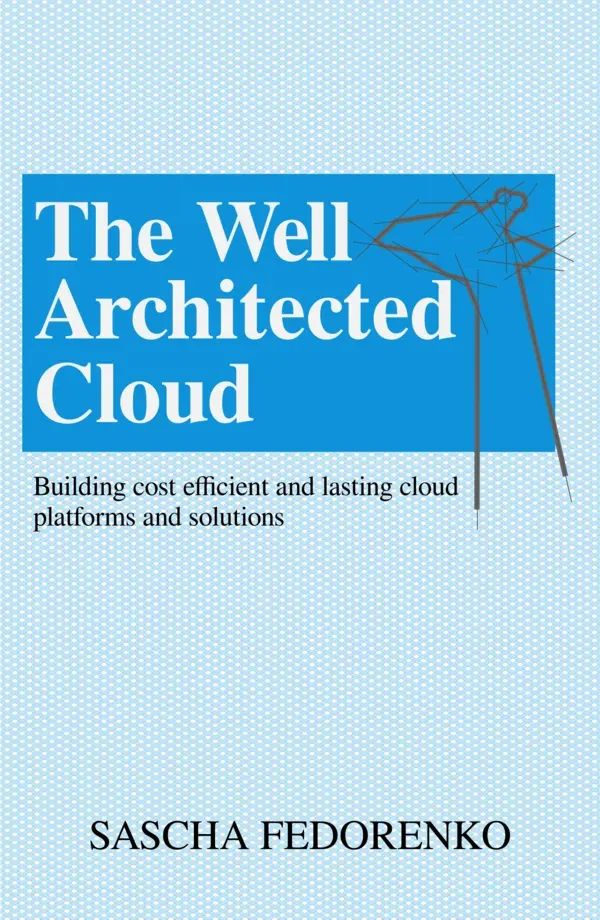
A physical copy is being prepared. I'm already adding new material, which should still make it into the first edition.
I'm really grateful to my family, friends and test-readers. As well as several people who don't even know they contributed: Werner Vogels and Gregor Hohpe, whose work defined the fundamentals of cloud and platform architecture (so that I don't have to write everything), and Barry O'Reilly, whose brilliant book on Residuality inspired me to write mine.
I'll be happy if you buy the book! And if we ever meet in person - let me know, and I'll gladly match your download with a signed physical copy (only on request and limited time only offer!).
Looks like I only need to plant a tree - my dill plant grew about a meter and survived all this summer's heatwaves, but that's still not a tree.
Stay tuned, stop aggressors and fight Nazis no matter what they pretend to be or the country they come from.
PS. No word of this blog is written by a GPT (I do use it to tell me I missed an article and such).
Comments ()